How to Start a Prayer Journal: A Beginner’s Step-by-Step Guide
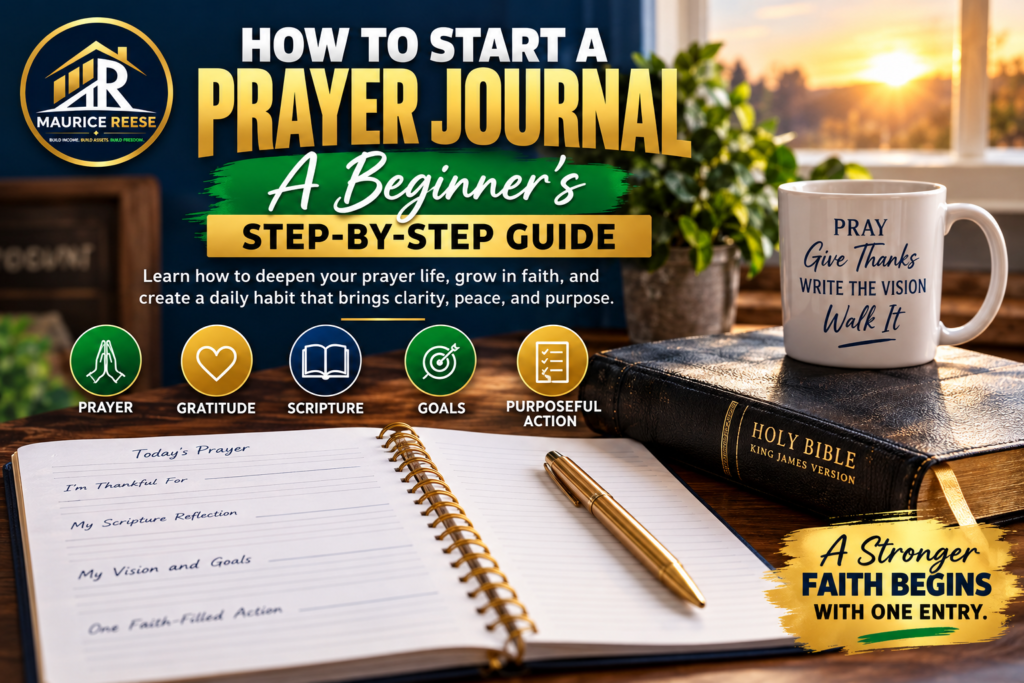
Learn how to develop a simple prayer journaling routine, reflect on Scripture, practice gratitude, and take faithful action one day at a time.
Have you ever sat down to pray but struggled to find the words? Between family, work, finances, and everyday responsibilities, it can be difficult to slow down and give your spiritual life the attention you want.
A prayer journal can help you become more intentional. You do not need fancy supplies, perfect handwriting, or an hour of free time. You need a willing heart, a place to write, and a simple plan.
This beginner’s guide explains how to start a prayer journal, what to write, and how to build a routine you can maintain.
What Is a Prayer Journal?
A prayer journal is a notebook where you record prayers, gratitude, Scripture reflections, questions, and experiences. Some journals also include space for personal goals and practical actions.
It is not a performance or a requirement for prayer. It is an optional tool that can help you focus, remember what matters, and notice patterns in your spiritual journey.
1. Begin With Prayer, Not Perfection
Your first entry does not need to be complicated. You could begin with a few sentences like these:
Heavenly Father, thank You for another day. Please give me wisdom for the decisions ahead, patience with the people around me, and a heart that recognizes Your goodness. In Jesus’ name, Amen.
First Thessalonians 5:17 (KJV) says, “Pray without ceasing.” The verse encourages an ongoing life of prayer, not a required number of journal pages. A few sincere sentences are a meaningful beginning.
2. Choose a Format You Will Actually Use
A plain notebook works well. A guided journal can be useful if you prefer prompts and dedicated writing space. Choose a format that feels approachable, whether it is a few minutes in the morning or a longer weekly reflection.
Look for room to record your prayers, gratitude, Scripture notes, priorities, and what you are learning. You do not need the most expensive journal; you need one you will return to.
3. Use Five Simple Prayer Journal Sections
Today’s Prayer
Write about what is on your heart. Include concerns about family, work, relationships, or money without feeling that you must have all the answers.
Three Things I Am Grateful For
List three blessings, even ordinary ones such as a conversation, an opportunity, or a new day. Gratitude gives you room to recognize what you might otherwise overlook.
Scripture Reflection
Read a short Bible passage in context. Ask: What does it teach about God? Who was the original audience? What principle can I thoughtfully apply today?
My Vision or Current Priority
Write down one meaningful goal, whether it involves personal growth, family, health, service, work, or wise financial stewardship. Clarifying a goal is not a guarantee of its outcome; it helps you think and plan responsibly.
One Faith-Filled Action
Choose one achievable action: encourage someone, review your budget, spend time with family, study Scripture, or complete a task you have been avoiding.
4. Try a Simple 10-Minute Daily Routine
| Time | Activity |
|---|---|
| 2 minutes | Read a short Scripture passage |
| 3 minutes | Write your prayer |
| 2 minutes | List three things you appreciate |
| 2 minutes | Reflect on a priority or goal |
| 1 minute | Choose one action for today |
If ten minutes feels too long, start with five. A sustainable rhythm matters more than an elaborate schedule. If you miss a day, simply begin again.
5. Ten Prayer Journal Prompts for Beginners
- What am I most thankful for today?
- What concern do I want to bring before God?
- Where do I need wisdom?
- What fear has been occupying my thoughts?
- Who needs my encouragement or prayer?
- What did I learn from Scripture this week?
- What habit would I like to improve?
- What meaningful goal am I working toward?
- How can I serve someone today?
- What is one faithful step I can take now?
Answer one or two questions at a time. These prompts are invitations to reflect, not boxes you must check.
6. Review Your Journal Once a Week
Set aside a few minutes to look back. What topics appear repeatedly? What has brought you gratitude? Have your priorities changed? Which actions did you complete, and what still needs attention?
A weekly review can help you connect your written reflections to everyday life without treating your journal as a scorecard.
7. Common Prayer Journaling Mistakes to Avoid
- Trying to write too much: a few thoughtful sentences are enough.
- Comparing yourself with others: your journal should reflect your own life and questions.
- Expecting instant outcomes: prayer is not a formula for controlling events.
- Writing only about problems: include gratitude, Scripture, and moments of growth.
- Giving up after missing a day: start again whenever you can.
8. Would a 90-Day Guided Prayer Journal Help?
Some people prefer to create their own structure. Others find that guided prompts make it easier to return to journaling each day.
Two guided journals to explore are Pray It. Write It. Walk It.: 90 Days of Prayer, Gratitude, Faith, Vision & Purposeful Action and Faith in Motion: 90 Days of Prayer, Gratitude, Faith, Vision & Purposeful Action by Mauricio Villalba. Faith in Motion includes 90 daily devotionals featuring KJV Scripture, prayer and gratitude exercises, vision and goal-writing space, daily action steps, evening reflections, weekly reviews, and 30-day milestones.
The central idea is simple: bring your concerns to God in prayer, write thoughtfully about your priorities, take a faithful next step, and trust God with the outcome. These journals are companions to prayer and Scripture, not substitutes for either.
Explore these Christian guided journals on Amazon:
- Pray It. Write It. Walk It. — View on Amazon
- Faith in Motion: 90 Days of Prayer, Gratitude, Faith, Vision & Purposeful Action — View on Amazon
Frequently Asked Questions
What should I write in my first prayer journal entry?
Begin with a brief prayer, one thing you are thankful for, a concern you want to express, and one action for the day.
Do I need a special journal?
No. Any notebook works. A guided journal can help if you like prompts and a repeatable structure.
How often should I write?
Start with a realistic frequency. Daily writing is one option, but a few times each week may be more sustainable at first.
Can I write about money and personal goals?
Yes. You can reflect on stewardship, budgeting, family responsibilities, and future plans while taking practical action and seeking sound advice where appropriate.
Is writing prayers the same as praying?
Written prayer is one way to express prayer. You can pray aloud or silently without a journal.
Final Thoughts: Begin With One Entry
You do not need to wait for Monday or a new year. Open a notebook, read a passage of Scripture, write a sincere prayer, name something you appreciate, and choose one meaningful next step.
Pray it. Write it. Walk it. Your journal does not have to be perfect to become useful.