The Financial Freedom Planner: A 12-Month Action Plan to Get Out of Debt and Build Income You Control
You work hard for your money. But there is a more important question: Is your money actually working for you?
You get paid.
The bills get paid.
Groceries, gas, insurance, subscriptions, credit cards and unexpected expenses all take their share.
Then another month ends and you are left asking the same frustrating question:
“Where did all my money go?”
You may even be earning more money than you did a few years ago and still feel like you are standing in the same place financially.
Maybe you have tried budgeting apps.
Maybe you have told yourself that next month will be different.
Maybe you started paying down debt but lost momentum.
Or maybe you already know that depending entirely on one paycheck is not where you want to remain, but you have never developed a clear plan for building additional income.
That is exactly why The Financial Freedom Planner was created.
Ready to Start Taking Control?
See The Financial Freedom Planner and begin building your 12-month financial action plan.
VIEW THE PLANNER ON AMAZON →Financial Freedom Starts With Knowing Where You Stand
You cannot improve what you refuse to measure.
Before worrying about becoming wealthy, investing thousands of dollars or creating multiple businesses, start with something much more basic:
Do you know exactly what is happening with your money right now?
Ask yourself:
- How much money is actually coming in every month?
- Where is that money going?
- How much debt are you carrying?
- How much are you saving?
- What financial goals are you actively working toward?
Many people cannot answer those questions with confidence.
Money comes in.
Money goes out.
Automatic payments happen. Credit card balances grow. Unexpected expenses appear.
Then another month disappears.
The Financial Freedom Planner is designed to help you get your finances out of your head and onto paper.
Once you can see your financial situation clearly, you can begin making more intentional decisions about what needs to happen next.
Stop Wondering Where Your Money Went
There is a major difference between hoping your financial situation improves and intentionally deciding what your money should accomplish.
Your goal should not simply be to record what you spent.
You want to begin giving your money direction.
Your Financial Priorities Might Include:
- Paying down high-interest debt.
- Building an emergency fund.
- Increasing monthly savings.
- Reducing unnecessary expenses.
- Building another source of income.
- Strengthening your financial position.
- Beginning to build assets for your future.
Instead of simply saying:
“I need to get better with money.”
You can begin asking:
“What exactly am I going to accomplish with my money this month?”
That is a much more useful question.
One Paycheck Is Not a Financial Plan
Your paycheck may support your household today.
But building greater long-term financial control requires thinking beyond the cycle of working, getting paid, paying bills and starting over again.
That does not mean you need to quit your job.
It means you begin thinking about ways to become less dependent on one source of income.
Ask yourself:
- What skill could I turn into additional income?
- Could I start a side business?
- Could I create an online income stream?
- Could I eventually own income-producing assets?
- Could something I already know become something people pay for?
The Financial Freedom Planner gives you a place to move those ideas from “one day” into written goals and action steps.
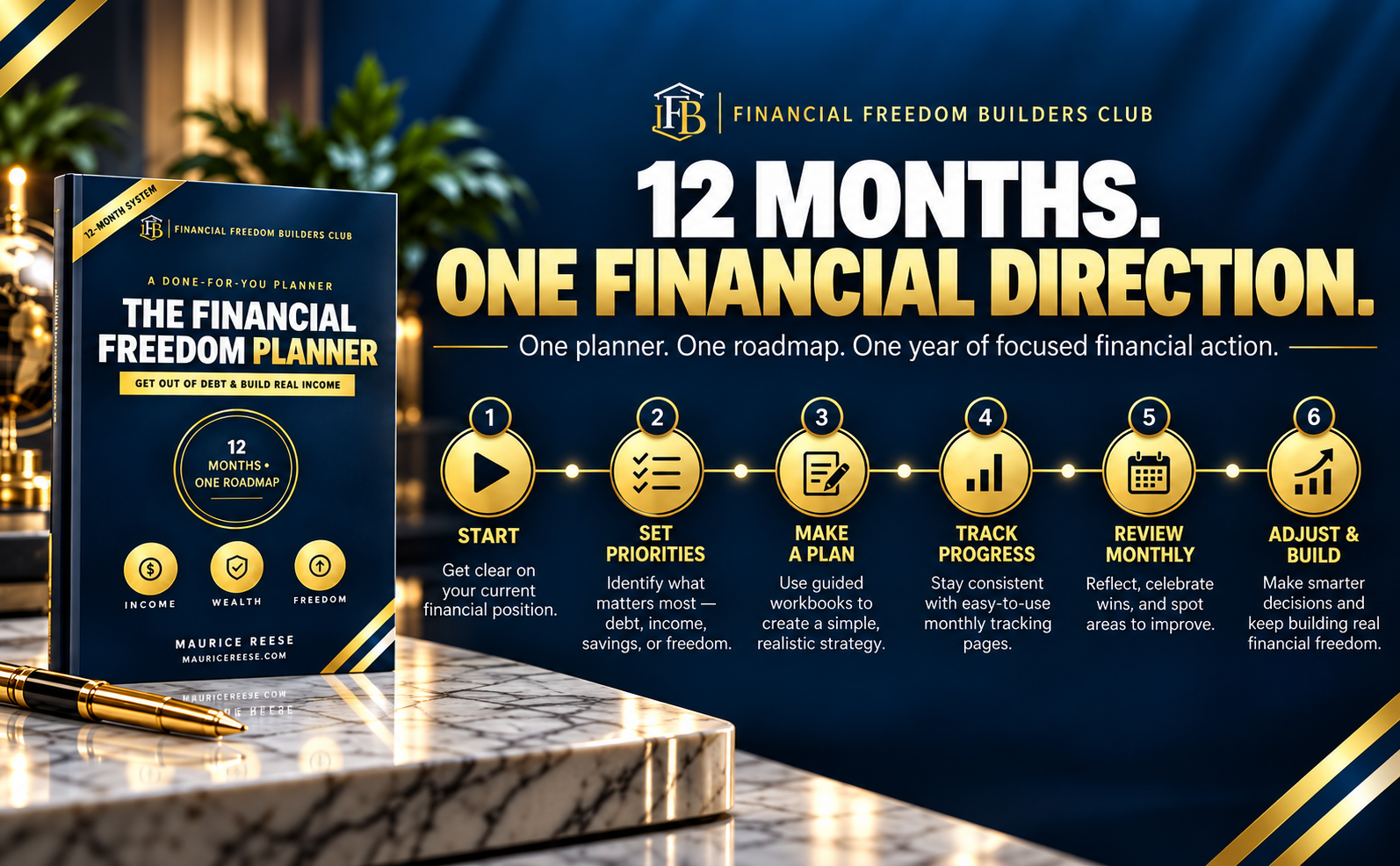
12 Months. One Financial Direction.
You do not have to fix your entire financial life overnight. You need a process for consistently making better financial decisions.
1. START
Get clear about where you are financially.
Look at your income, expenses, debt, savings and current financial priorities.
2. PLAN
Decide what you want your money to accomplish.
Establish priorities and turn larger goals into smaller, actionable steps.
3. TRACK
Pay attention to what actually happens with your money.
You cannot effectively manage something you consistently avoid measuring.
4. REVIEW
Look back at your financial activity and progress.
Ask:
- What worked?
- What did not work?
- Where did I improve?
- Where did I get off track?
5. ADJUST
Financial plans change.
Unexpected expenses happen. Income changes. Priorities change.
The goal is not perfection.
The goal is to use what you learned to make the next decision with better information.
6. BUILD
Keep building month after month.
- Build better financial habits.
- Build savings.
- Build income.
- Build assets.
- Build greater control over your financial future.
Getting Out of Debt Requires More Than Making Minimum Payments
Debt can quietly take control of your financial life.
You work for your paycheck, but before you decide what to do with it, portions of that money may already belong to credit cards, vehicle payments, personal loans and other obligations.
That is why debt reduction is part of the bigger financial freedom picture.
The question is not simply:
“Can I make my minimum payments?”
A more useful question is:
“How can I gradually reclaim more control over my income?”
Reducing debt can give you more flexibility over where future income goes.
Building Income Matters Too
Cutting unnecessary expenses matters.
You can cancel subscriptions, reduce impulse purchases, eat out less, shop more carefully and look for ways to lower recurring expenses.
Those changes can help.
But there is eventually a limit to how much you can cut.
Income is different.
Income has room to grow.
That is why The Financial Freedom Planner encourages you to think about both sides of your financial equation.
Control what leaves your household while looking for ways to increase what enters it.
Financial freedom is not simply about becoming an expert at spending less.
It is also about developing your ability to earn, build, own and create.
Imagine Knowing Exactly What You Are Working Toward
Imagine opening your planner at the beginning of the month and already knowing your priorities.
Imagine seeing your goals written down instead of carrying all of them around in your head.
Imagine looking back three months, six months or twelve months and being able to see the decisions you made along the way.
Over time, you may begin seeing:
- Greater awareness of where your money goes.
- Debt balances moving in the right direction.
- More intentional saving.
- Better financial habits.
- Income ideas turning into action.
- Greater clarity about your financial priorities.
There is something powerful about seeing your financial progress written down.
Who Is The Financial Freedom Planner For?
This planner was created for everyday working people who know they need to make financial changes but want more structure for following through.
It may be especially useful if you:
- Feel like your paycheck disappears too quickly.
- Want to become more organized with your money.
- Are serious about reducing debt.
- Want a written financial action plan.
- Want to develop stronger money habits.
- Want to increase your income.
- Are interested in creating multiple streams of income.
- Want to begin building assets.
- Have financial goals but struggle with consistency.
- Want a system you can continue using throughout the year.
You do not have to have everything figured out before you begin.
You simply need to be willing to start.
This Is Not a Get-Rich-Quick Promise
A planner cannot magically eliminate debt.
It cannot create income while sitting unopened on a shelf.
And it cannot make difficult financial decisions for you.
You still have to do the work.
That is exactly the point.
The Financial Freedom Planner gives you a place to organize that work.
A place to make decisions.
A place to establish priorities.
A place to review your progress.
And a place to keep moving forward.
Financial freedom is rarely the result of one giant decision.
It is more often built through many smaller financial decisions made consistently over time.
Your Next 12 Months Are Going to Pass Anyway
Think about where you were financially twelve months ago.
Now think about where you could be twelve months from today if you became more intentional with every month in between.
You do not need another year of saying:
“I really need to get my finances together.”
You need a plan.
You need a system.
And most importantly:
You need to start.
Start Your Financial Freedom Plan
Stop simply wondering where your money went.
Start deciding where your money should go and what you want your money to help you build.
Know where you stand. Make a plan. Measure your progress.
VIEW THE FINANCIAL FREEDOM PLANNER ON AMAZON →The Financial Freedom Planner is intended for educational, organizational and informational purposes. It does not constitute financial, investment, legal, accounting or tax advice. Individual circumstances and results vary.